
![[Most Recent Quotes from www.kitco.com]](https://lh3.googleusercontent.com/blogger_img_proxy/AEn0k_vcqW8-RecmoaWcUOkecb_2Y5jHvnpirrSKo-oJ2Y6IYfygG22jgBaq7s1Q7lt7Vq84mPcKPHF-US8mu1ca4aQsM0rX1cUjgCWoaBCpVuoHOlGvvUBpV83DDeR30Uvpm_51EOiiLolc=s0-d)
![[Most Recent Quotes from www.kitco.com]](https://lh3.googleusercontent.com/blogger_img_proxy/AEn0k_t3EItHwAofUj0g-uuCGuOOIV8GZ9QzThO2b90KvgBlgq9jlZ3mxSafGRHNk8zWBJwWKIuvuFUxnYZRz4KluIF_whJqhakOYqagAdJvG4EhbbWxBnqp0KbZt4iQIkQXPfdA5gMNXKio=s0-d)
![[Most Recent Quotes from www.kitco.com]](https://lh3.googleusercontent.com/blogger_img_proxy/AEn0k_sP49Ta5l3R_oc6w8cDPUUue5WwaADLLQd4xoOcc6KARhb3w_zkOdeiTQGyty1OO7HyKly8ApIx3emZBTFtRw_CuIdLkglYKKbr7QyPj7zRz4iil_T6S8fdoEnKRiVgUUGG4dSRfMs=s0-d)
![[Most Recent Quotes from www.kitco.com]](https://lh3.googleusercontent.com/blogger_img_proxy/AEn0k_vq_vkfgNuZrvvudZMa_NaTcOYj5YMGfP3oy3xglUVyKytatM8HW6cqoDwtuAsrx-gVkeY4DOy7ZjrkV8-n0n5ueL4TGkcmb-EFNlmLA1mTphfy0AoJXiO7fahnRryeiEuDH487a0U=s0-d)
By Frank Holmes|Oct 15, 2010, 6:14 PM

We talked earlier this week about the long-term prospects for copper prices but palladium has been the star performer of metals this year. As of yesterday, palladium is up 47 percent in 2010 to $602.75 an ounce.
Palladium has benefited from a rebound in global auto production, which is expected to jump 20 percent from 2009 levels this year. Palladium is used in catalytic converters for automobiles. The average catalyst contains 4 grams of palladium or platinum. With China building between 15-20 million new automobiles a year, much more of the metals will be needed.
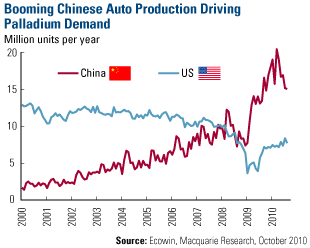
Auto production in China has receded in recent months from its peak earlier this year but remains three times higher than it was just a few years ago. In addition, Macquarie says there is a regulatory bias in China toward regular gasoline vehicles over diesel. Gasoline engines use more palladium for catalyts while diesel engines rely more on platinum. We’ve also seen a rebound in the U.S. auto market. Production has bounced off of 2009 lows and a report from Experian this week shows new-car registrations rose for the third-consecutive quarter in June. Car registrations were up 13.5 percent from the same period last year.
Like copper, palladium has solid supply/demand fundamentals. Total demand is expected to increase 43 percent from 2009-2015, nearly all of that coming from the automobile industry. Meanwhile, mine supply is only expected to rise by 2 percent over the same time period.
We talked earlier this week about the long-term prospects for copper prices but palladium has been the star performer of metals this year. As of yesterday, palladium is up 47 percent in 2010 to $602.75 an ounce.
Palladium has benefited from a rebound in global auto production, which is expected to jump 20 percent from 2009 levels this year. Palladium is used in catalytic converters for automobiles. The average catalyst contains 4 grams of palladium or platinum. With China building between 15-20 million new automobiles a year, much more of the metals will be needed.
Auto production in China has receded in recent months from its peak earlier this year but remains three times higher than it was just a few years ago. In addition, Macquarie says there is a regulatory bias in China toward regular gasoline vehicles over diesel. Gasoline engines use more palladium for catalyts while diesel engines rely more on platinum. We’ve also seen a rebound in the U.S. auto market. Production has bounced off of 2009 lows and a report from Experian this week shows new-car registrations rose for the third-consecutive quarter in June. Car registrations were up 13.5 percent from the same period last year.
Like copper, palladium has solid supply/demand fundamentals. Total demand is expected to increase 43 percent from 2009-2015, nearly all of that coming from the automobile industry. Meanwhile, mine supply is only expected to rise by 2 percent over the same time period.
If demand for automobiles continues to rise in China, the U.S. and other emerging markets such as Brazil, Russia and India, it’s possible we could see a large deficit in supply during the next couple of years.


